When family history warrants genetic counselling and what testing can clarify.
Family history is not destiny
Most melanomas are not caused by an identifiable inherited syndrome. Multiple cases in a family can reflect genetic susceptibility, skin characteristics and shared exposure habits. Cancer itself is not inherited: some people inherit a variant that increases its likelihood. Even in a susceptible family, carrying a variant does not mean that cancer will inevitably develop.
Germline pathogenic variants are present from birth and can be passed on. Somatic tumour alterations, such as many BRAF mutations, are tested to guide treatment and do not by themselves prove an inherited risk for children. This distinction prevents a tumour profiling report from being misread as a familial genetic test.
CDKN2A is an important gene in selected families with multiple melanomas and can also be associated with pancreatic cancer. Its p16 and p14ARF proteins participate in controlling cell growth; CDKN2A should not be confused with unrelated genes appearing in older descriptions. Other familial patterns may involve CDK4, BAP1, POT1 or additional genes. MC1R affects pigmentation and susceptibility but is not automatically equivalent to a high-penetrance cancer syndrome.
Sources: GeneReviews — CDKN2A Cancer Predisposition, 2025; MedlinePlus Genetics — CDKN2A.
When to seek genetic counselling
Multiple primary melanomas in one person, several relatives with melanoma, unusually early diagnoses or combinations with pancreatic and other characteristic cancers warrant discussion. Criteria for offering testing depend on geography, family structure and tumour types; no single numerical threshold should be applied without taking a pedigree.
Collect ages at diagnosis, family relationships, reports and tumour sites when available. Cutaneous melanoma, uveal melanoma and a brain tumour are not interchangeable pieces of information. A genetic specialist considers whom to test first, often an affected relative, and which panel is appropriate. Clinical testing is available today: the old statement that testing is restricted to research is outdated.
A positive result can enable targeted family testing and surveillance. A negative result does not remove all familial risk, particularly if no causal family variant has been identified. A variant of uncertain significance should not be treated as a pathogenic diagnosis. Counselling addresses limitations, possible outcomes, consent, privacy and implications for relatives.
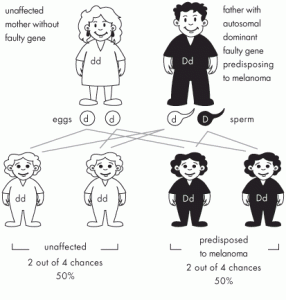
In autosomal dominant conditions, a carrier parent has a 50% chance of passing the variant to each child. That is not the child’s probability of developing melanoma. Testing minors requires specific consideration of clinical benefit and the age at which interventions begin, rather than indiscriminate commercial testing.
Skin surveillance and other organs
Skin surveillance combines examination, dermoscopy and photographs when useful. Frequency depends on the variant, personal history and mole pattern; monthly specialist visits for everyone are not a valid general rule. Agreed self-examination helps identify changes without replacing professional review. UV protection and avoiding sunbeds remain important even when risk is inherited.
For carriers of pathogenic CDKN2A variants, pancreatic surveillance is considered in experienced centres using dedicated protocols. It is not equivalent to occasional abdominal ultrasound or self-requested tumour markers. Certain variants affecting p14ARF and particular family histories require attention to nervous system tumours; the linked melanoma–astrocytoma page explains this issue.
Other rare syndromes, such as xeroderma pigmentosum or BAP1 predisposition, have their own pathways. Inclusion in a historical list does not mean that every melanoma family needs every genetic test or whole-body MRI. Agreeing which relatives to inform, how to share a genetics letter and who will update the surveillance plan as knowledge changes makes counselling practically useful.
Sources: GeneReviews — CDKN2A Cancer Predisposition, 2025; MedlinePlus Genetics — CDKN2A.
Sharing results without creating alarm
Counselling can have emotional consequences even for relatives who never develop cancer. Ask for help communicating findings and distinguishing relatives who may benefit from testing from those without an indication. A clear genetics letter is more useful than a screenshot from a commercial laboratory. Before testing, ask about coverage and access to local surveillance.
Small families, unavailable relatives and unknown diagnoses may leave the picture incomplete. This limitation should be acknowledged rather than replaced by an invented risk percentage. The plan can be updated when new clinical information appears or a variant is reclassified.
Editorial review and source consultation: 17 October 2026. Educational information, not individual healthcare or benefits advice. Source checking does not certify a new specialist clinical validation.