Organic filters, mineral filters and formulations
Sunscreens contain filters that reduce the UV radiation reaching the skin. They may combine organic filters, often called “chemical”, and inorganic or mineral filters such as zinc oxide and titanium dioxide. The distinction should not be reduced to “one absorbs and the other reflects”: mineral filters also absorb radiation, alongside scattering and reflection.
Individual ingredients have different absorption profiles; protection depends on the complete formulation and product testing, not the name of one filter. Historical ingredient lists are not an updated catalogue of what is authorised in every country: availability, permitted concentrations and rules change. Consumers should use a product compliant with the market where it is sold and carrying complete labelling.
Creams, lotions, gels, ointments, sticks and sprays can make application easier on different areas. A cream may suit dry skin, a gel hairy areas and a stick small sites. Sprays require care with quantity, wind and inhalation: do not spray directly onto the face and follow warnings, including flammability warnings where present.
SPF and broad spectrum: reading both
SPF stands for Sun Protection Factor. It is a standardised measure of protection against sunburn, mainly associated with UVB; alone it does not fully describe UVA protection. Broad-spectrum UVA/UVB coverage therefore also needs to be checked. Sunscreen is not only for the beach: snow, high altitude and prolonged outdoor activity may require it in other seasons.
General American Academy of Dermatology advice includes SPF at least 30, broad-spectrum protection and water resistance. SPF 50 or 50+ may be appropriate for particularly sensitive skin, children as advised and demanding circumstances. A higher value does not remove the need to apply the product properly or reapply it.
Theoretical filtration percentages do not describe real-world use on their own. Under standard conditions, SPF 15 corresponds to filtering about 93% of sunburn-effective radiation, SPF 30 about 97% and SPF 50 about 98%; these are not percentages of melanoma risk reduction. Too little product or uneven coverage reduces the protection achieved.
SPF is not a calculation of safe hours
Do not multiply the minutes you think you tolerate in sunlight by the sunscreen’s SPF. The example “30 minutes × SPF 15 = 7.5 hours” is not a usable exposure rule: UV intensity, applied quantity, sweat, water and friction change throughout the day. Damage is also not limited to the appearance of visible sunburn.
No sunscreen guarantees total protection or makes intentional tanning safe. Combine shade, UV-protective clothing and hats, and sunglasses. Higher protection is an additional measure, not a credit of time to spend in sunlight.
The old suggestion of a universal 90-minute duration is also too rigid: follow product instructions and reapply about every two hours outdoors, sooner when water, sweat or towelling require it. Reapplication does not erase exposure already received.
Quantity, even coverage and forgotten areas
Apply the product to dry skin before going out, following the timing on the label. Declared performance is measured using specific quantities: an adult with much of the body uncovered needs approximately 30 millilitres, varying with body size and exposed area. A very thin film is not equivalent to the tested amount.
Spread it evenly over the neck, ears, backs of the hands, feet and other uncovered areas. A stick can be convenient for the nose and small sites, but enough passes are needed to leave adequate coverage. Protect lips with a suitable product; avoid eye contact and remember areas left exposed by swimwear, hats or hair.
Make-up with SPF or a small amount of face cream may not provide sufficient protection for a long day outdoors. The choice needs to be workable: a well-tolerated formulation applied correctly is more useful than a product left in a bag because it is unpleasant to use.
Water resistance and reapplication
“Water-resistant” does not mean permanently waterproof. Tests assess defined conditions and labelling may differ between markets; US labels, for example, may state 40 or 80 minutes. These are not safe sun-exposure times and do not override the instructions for the product being used.
After swimming, heavy sweating or towelling, renew protection as directed. Towels and clothing friction can remove product. Simply allowing the skin to air-dry does not guarantee that the protective layer remains even.
UV exposure can continue in water. For children, prolonged swimming and water sports, also consider suitable covering garments and shaded breaks. Do not entrust all protection to a claim on the packaging.
Sensitive skin, allergies and storage
A reaction may be due to filters, fragrance, preservatives or other components. Mineral formulations may help in some cases but do not guarantee freedom from allergy or irritation. If symptoms persist, stop the suspected product and ask a clinician or pharmacist; a true allergy requires identifying the ingredient rather than random substitution.
For babies under six months, shade and clothing take priority, with paediatric advice before sunscreen use. People with photodermatoses or taking photosensitising medicines may need additional measures. No filter should be presented as universally ideal for every skin type.
Check expiry, period after opening and storage conditions. A change of calendar year alone does not mean every bottle must be discarded, but an expired, altered or heat-damaged product should not be relied upon. Avoid leaving it in a car or direct sunlight and keep the label readable.
Historical images and a changing message
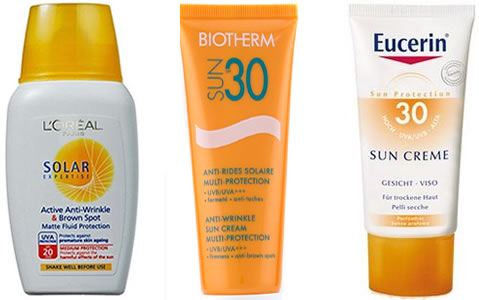
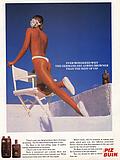
The history of sunscreens includes formulations developed for different needs and a long advertising tradition centred on tanning. The archive images retained here document that language; they are not a selection of recommended products or evidence of their current effectiveness.
The previous chronology credited a single inventor and linked the aftermath of the First World War with products used during the Second: that account is not sufficiently reliable to repeat as fact. The useful prevention message is the shift from “tanning more” towards reducing UV damage. A brand or historical advertisement does not replace reading the label and following updated guidance.

Sources and update
- American Academy of Dermatology — Sunscreen FAQs
- FDA — Sunscreen: how to help protect your skin
- WHO — Ultraviolet radiation
- FDA — Should you put sunscreen on infants?
- Cole et al. — Metal oxide sunscreens protect skin by absorption (2016)
Editorial revision: 17 October 2026. Educational information that does not replace medical assessment.