The iris, nevi and melanoma
The iris is the coloured part of the eye and belongs to the uvea. Iris melanoma arises from its melanocytes. It is distinct from choroidal and ciliary body melanoma, although a lesion can extend into neighbouring structures.
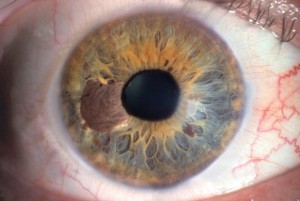
Distinguishing it from an iris nevus can be difficult but should not be described as invariably impossible. Appearance, documented growth, structural involvement and specialist investigations are combined to decide between observation and treatment. An iris mark is not automatically malignant.
Possible changes and symptoms
It may appear as a circumscribed pigmented or poorly pigmented lesion, sometimes with diffuse growth. Pupil distortion, iris colour change, intraocular bleeding, persistent inflammation and raised eye pressure need assessment. Heterochromia means a colour difference, not a diagnosis of melanoma.
Glaucoma can result from angle involvement or other mechanisms. A threshold of 66% of the circumference cannot be used by patients to predict or exclude it. Pain or sudden worsening of vision needs prompt assessment.
Investigations and documented observation
Slit-lamp examination and photographs describe the lesion and allow comparison over time. Gonioscopy examines the angle; transillumination and ophthalmoscopy may complete assessment. Ultrasound biomicroscopy measures thickness and relationships with the ciliary body, angle and sclera.
Anterior segment angiography can show vascularity but cannot establish malignancy alone. Biopsy or resection is considered when the result would change management. Observation of a selected lesion means scheduled specialist follow-up with comparable measurements, not waiting without review because it causes no symptoms.
Treatment, vision and prognosis
Eye-preserving treatment is preferred when appropriate. Local resection and radiotherapy, including brachytherapy, may be suitable according to size and distribution; radiotherapy is not restricted exclusively to inoperable lesions. Enucleation is considered for extensive disease or situations unsuitable for conservative control.
Iris melanoma series generally show more favourable outcomes than posterior uveal melanoma series, partly because lesions are often detected earlier. The greater than 95% five-year survival reported by the NCI is a group statistic, not an individual guarantee. Extent and lesion characteristics guide ocular and systemic surveillance.
Ask which changes would justify treatment, what visual effects are possible and how follow-up will be organised. Keep photographs and reports to support reliable comparison over time.
Sources and update
Editorial revision: 17 October 2026. This information does not replace medical assessment. For very rare variants, some evidence comes from small series or case reports.