The ABCDE rule highlights changes to discuss with a dermatologist. You do not need to identify every feature or wait for two to appear: even one suspicious sign warrants assessment.
The images support the explanation. Do not use them to decide whether your own mole is benign or malignant.
Asymmetry
The two halves look different
Imagine dividing the spot in half: one side may differ in shape from the other. This is a feature to have assessed, not a diagnosis.
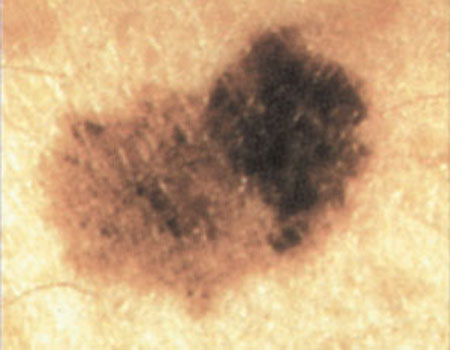
Border
An uneven outline
Look for edges that are notched, irregular or poorly defined. An irregular mole is not necessarily melanoma: a dermatologist needs to assess it.
Colour
Different shades within one spot
Uneven colour, including brown or black areas and sometimes white, red or blue patches, is a change to discuss with a doctor. A difference from the usual appearance also matters.
Diameter
Size matters, but is not enough
A diameter greater than 6 mm is one of the warning signs. Melanoma can also be smaller: do not wait for a spot to reach this size before seeking advice.
Evolving
Changes over time
A spot that changes in size, shape or colour, or looks different from the others, deserves attention. Itching or bleeding are also reasons to speak to a doctor.
When to seek advice
Contact your doctor or dermatologist about a concerning new spot, a mole unlike your other moles, or a change in an existing lesion. Mention bleeding, itching or a sore that does not heal.
The absence of ABCDE signs does not rule out melanoma. Some melanomas do not follow this pattern. Do not delay an appointment while waiting for further changes.
How a suspicious lesion is assessed
A dermatologist examines the skin and may use dermoscopy. If a lesion is suspicious, they may recommend removing it for histological examination, which can confirm the diagnosis.
Continue with the guide to recognising the signs and diagnosis.
Sources and update
- American Academy of Dermatology — ABCDEs of melanoma: ABCDE features and smaller lesions.
- American Cancer Society — Signs and symptoms of melanoma: additional signs and limitations of the rule.
- Fondazione AIRC — Cutaneous melanoma (Italian): diagnostic assessment.
Editorial update and sources consulted: 16 October 2026. This page provides information and does not replace a medical assessment.